
Over the past few years there has been a tendency, especially by those in the financial press, to play it fast and loose with economic jargon. Buzzwords replace actual understanding of issues and the fourth estate transmits these so-called truisms to the public. This can be highly misleading, and often it proves dangerous, especially if these fallacies take hold inside the Beltway or in Brussels.
A current meme is that Google and Facebook, among other popular web services, are “natural monopolies.” In an impressive flourish of sophistry, James Stewart at the Wall Street Journal describes a natural monopoly as “a company that invents (or stumbles upon) a business model or technology impossible to replicate.” Sounds good, but incredibly wrong for two reasons: First, that is not the definition of a natural monopoly, and second, Facebook and Google’s technology is difficult, but not impossible, to replicate. As a result, they must constantly innovate or be overtaken—or invented around.
Despite the catchiness of the phrase “natural monopoly” the term has real meaning in economic and regulatory circles. A natural monopoly—a concept that is even controversial among economists—is characterized by high upfront costs, extreme economies of scale and non-differentiated products. As a result, competition is economically infeasible and even wasteful. The most commonly cited examples of natural monopolies are the components of our physical infrastructure of that undergird modern society: roads, airports, ports, water supply systems, electric power transmission systems and telephone lines (there is debate whether the last two are actually natural monopolies or just good old-fashioned monopolies). Why are these natural monopolies? Because, in most cases, it is simply not practical to build competitive roads that link the same locations or to construct multiple water lines to individual houses. This confers extreme economic power to the provider of the service, and as a result, heavy government regulation (or in some cases actual government provision) is necessary.
Websites, no matter how popular, are not natural monopolies. When was the last time you heard of a public utility starting up in someone’s garage? The dynamics of the Internet marketplace, specifically the websites and applications that make up the content layer of the Internet, do not tend towards the creation of natural monopolies. Quite the opposite.
The Internet is characterized by extremely low up front costs and minimal barriers to entry. It is this dynamic that might create the illusion of a natural monopoly, because the Internet as a medium has done away with the “tyranny of distance.” On the Internet, consumers can flock to the best product or service en mass almost instantly. This means the best product or service often quickly gains impressive market share. However, the same dynamics that precipitated the rise of companies like Google and Facebook also place extreme competitive pressure on them. Certainly Facebook and Google are difficult to compete against, but that stems from the quality of their products and the consistency of their innovation. Not only do they face direct competition, but they are also constantly looking over their shoulders because they know that the next Mark Zuckerberg or Sergey Brin is staying up late in his or her dorm room thinking about how to dislodge them—not to mention Steve Ballmer and Steve Jobs who are Binging and Pinging all through the night as well.
Does this mean that the regulators should take a completely hands off approach to the Internet market? Certainly not. Unfair and deceptive practices should be dealt with swiftly and consumer choice should be encouraged. However, it does mean that regulators should handle with care because increasing regulatory burdens increase barriers to entry and threaten to harm the Schumpeterian competition that has characterized this dynamic space. The danger is if regulators begin to mistakenly view the Internet as a breeding ground for “natural monopolies” then they might regulate it as such, thus killing the Darwinian dynamic that currently exists and creating the very beasts they aim to curtail. As prominent Internet scholar Tim Wu recently pointed out, “no one has ever conceived a better way of scotching competitors than to make them comply with complex federal regulation.”
Humans, this includes journalists, are inherently myopic. World War 1 would end all wars, the Age of Aquarius would usher in a new era of peace and love, and securitized finance would make risk obsolete and end those pesky boom and bust cycles. Even if humans forget, history does repeat itself and the short history of the Internet should teach us how fickle market power really is in this space, at least on the content layer (now, the infrastructure layer of the internet is a different story and much closer to a natural monopoly than the content layer). Remember when MySpace was a “natural monopoly”? I don’t.
News
April 23, 2026
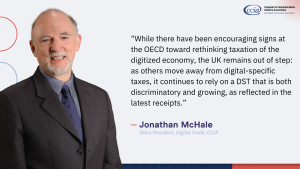
CCIA Comments in Response to UK Publishing its Annual Digital Service Tax Collection Amounts
London – Today, the UK’s HM Revenue and Customs published its annual tax receipts for 2025-26, including the total amount made payable to its digital services tax (DST), which totalled £944m (aro...
News

April 23, 2026
DMA Reality Check Needed as First Review of EU ‘Gatekeeper’ Law Approaches
Brussels, BELGIUM – With the European Commission’s first formal review of the Digital Markets Act (DMA) expected in the coming days, the tech sector is calling for a rigorous, evidence-based asses...
News

April 22, 2026
CCIA Continues to Raise Concerns with Alaska Social Media Bill HB 318
Washington – As Alaska lawmakers continue to consider HB 318, the Computer & Communications Industry Association is urging careful review of the proposal, citing ongoing concerns about its impac...